

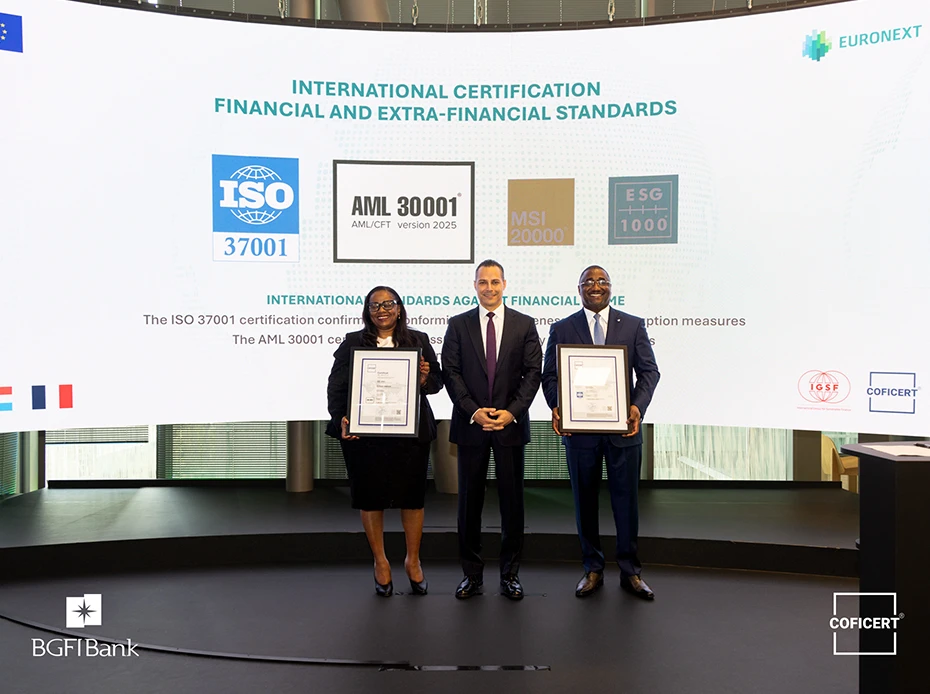
Stella Bongotha, Souheil Skander, Abakal Mahamat
BGFIBank Cameroun stands out for holding dual certification in the field of financial crime prevention, covering corruption as well as anti-money laundering and counter-terrorist financing. In this interview, Stella Bongotha, Compliance Director at BGFIBank Cameroun, gives us a behind-the-scenes look at the certification process, how it works day to day, and the structural effects it has had on the organization’s governance.
What is BGFIBank Cameroun’s relationship with certification?
BGFIBank Cameroun has a close relationship with certification, which it views as a genuine lever for operational excellence, risk management, and trust. To date, the bank has obtained several international certifications, including ISO 37001, dedicated to anti-corruption management systems, as well as the renewal of its AML/CFT certification for combating money laundering and terrorist financing. This makes it the first bank in Cameroon and Central Africa to hold both of these financial crime prevention certifications at the same time.
BGFIBank Cameroun is also certified to ISO 9001 V. 2015 for its quality management system, and to PCI DSS, the leading international standard for payment card data security. These various certifications reflect senior management’s ongoing commitment to applying international best practices in governance, compliance, security, and service quality.
What concrete impact has certification had on your organization?
Obtaining and renewing these certifications has had a structural impact on our organization. Beyond the external recognition, they require us to pursue continuous improvement, regularly reassessing our procedures, control systems, tools, and working methods to keep them aligned with international best practices.
In concrete terms, this has allowed us to strengthen our anti-corruption management system and reinforce our financial security framework, improve the performance of our screening and profiling tools, and build a genuine compliance culture at every level of the bank. It has also translated into stronger awareness and training initiatives across the entire workforce.
This dual recognition rests above all on a collective effort, and I’d like to thank the Compliance team in particular, as well as the other colleagues who helped us reach this milestone.
What challenges lie ahead? And what would you say to companies that are still hesitant?
Our next challenges will above all be about sustaining these certifications over time. The goal isn’t just to obtain or renew them, but to keep integrating them fully into our day-to-day operations. That means continuing to strengthen our framework, constantly adapting our practices to evolving risks, regulatory requirements, and international standards.
To companies still hesitant about pursuing certification, I’d say it’s a strategic investment far more than a constraint. Beyond the recognition it brings, certification helps structure processes, strengthen governance, improve risk management, and build greater trust among customers, partners, and supervisory authorities.
The more companies adopt these excellence frameworks, the more our entire economic ecosystem will gain in transparency, resilience, and credibility.