

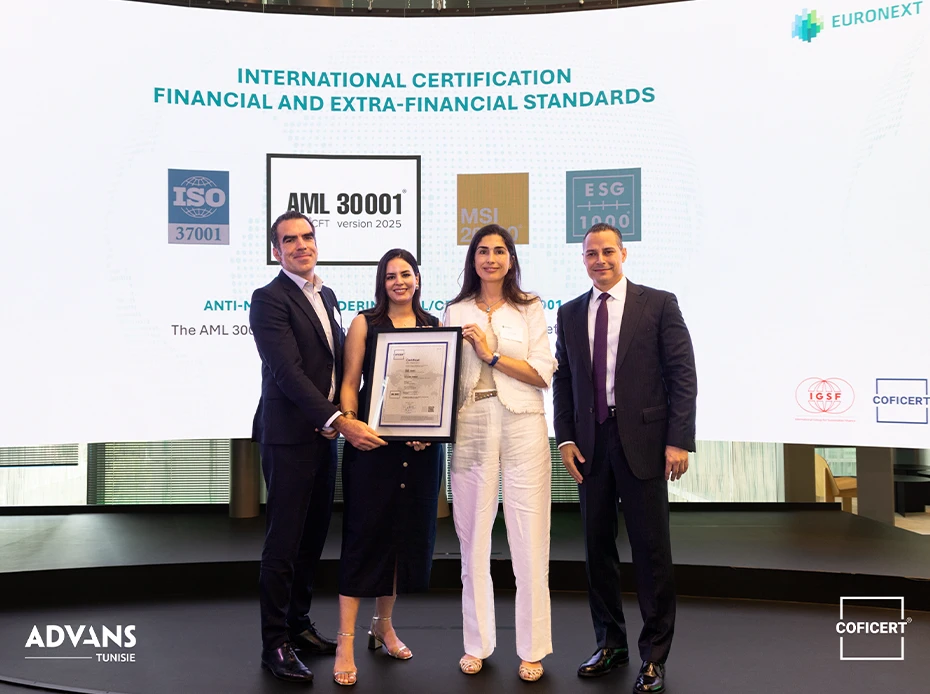
Grégoire Danel-Fédou, Chaïma Chawali, Meriem Zine, Souheil Skander
Advans Tunisie, a subsidiary of the international Advans group, is a leading player in microfinance in Tunisia. The institution provides ethical, responsible, and sustainable financial and non-financial services to micro, small, and medium-sized enterprises (MSMEs). In this interview, Meriem Zine, Chief Executive Officer of Advans Tunisie, and Chaïma Chawali, Head of Compliance, discuss their approach in a particularly exposed sector, through obtaining AML 30001 certification, dedicated to combating financial crime, notably money laundering and terrorist financing.
Certification: What are the benefits? What are the essential steps?
Meriem Zine: This certification is, first and foremost, a guarantee of credibility and trust. It demonstrates that our institution has a robust anti-money laundering and counter-terrorist financing framework in place, aligned with international standards. It also strengthens our relationship with our customers, the regulator, financial partners, and funders, while improving risk management and the quality of our internal governance.
Chaïma Chawali: AML 30001 certification is above all a framework that makes our compliance system more structured, traceable, and auditable. It helps us strengthen risk detection, the quality of our KYC process, and the effectiveness of suspicious transaction monitoring. In practice, the process begins with a gap analysis between the standard’s requirements and our own practices, after which we work on improving procedures, control tools, and documentation. Particular emphasis is placed on customer risk management and transaction monitoring systems. Finally, we validate everything through internal testing and an independent audit, to ensure the system is fully operational and meets the certification’s requirements.
What impact has certification had on your business?
Meriem Zine: AML 30001 certification has had a structural impact on our business. First, it strengthens the trust of our partners, our customers, and the regulatory authorities, which is essential for a microfinance institution. Internally, it improves our governance and operational discipline, with better formalized processes and more rigorous risk management. This translates into better control of compliance risk and greater security for our operations.
Finally, it’s also a lever for professionalization and sustainability: it pushes us to continually improve our practices and strengthen our institution’s soundness over the long term.
What are your next challenges?
Meriem Zine: Our next challenges are about consolidation and growth. First, we need to build on the gains from AML 30001 certification and keep strengthening the trust of our partners and the market. We also need to support the growth of our business while maintaining a high level of risk control, in an increasingly demanding regulatory environment. Finally, another priority is continuing to digitalize our processes to gain efficiency and agility.
Chaïma Chawali: From a compliance standpoint, the main challenge is keeping the system alive and effective, not just compliant at the moment of certification. That means continually strengthening transaction monitoring, adapting to new risk typologies, and improving the quality of our alerts. We’re also working on digitalizing controls and automating certain anti-money laundering and counter-terrorist financing processes, so we can respond more quickly. Finally, a key challenge remains our compliance culture, in particular through ongoing staff training and embedding AML habits at every level of the company.
What would you say to companies that are still hesitant?
Chaïma Chawali: AML 30001 certification is, above all, a structuring process that brings order, formalizes practices, and strengthens what’s already in place.
Of course, it requires an investment of time and organization, but the benefits are real: better risk management, clearer processes, and more robust day-to-day compliance. It’s also an excellent way to professionalize teams and build a lasting culture of vigilance.