

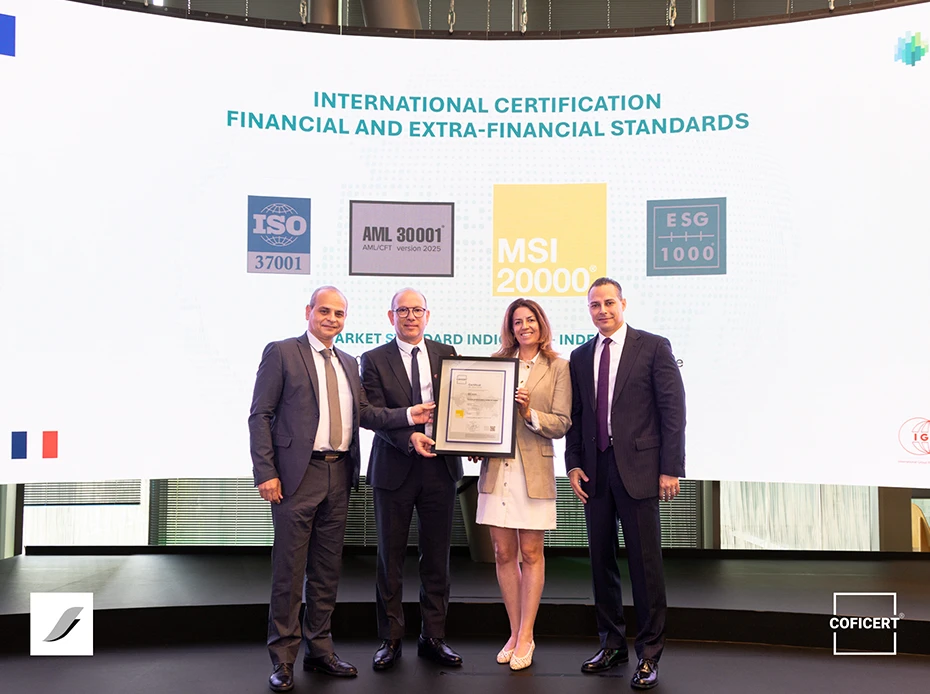
Hassen Longo, Elyes Jebir, Khansa Bouassida, Souheil Skander
BIAT, the leading bank in Tunis, has renewed its MSI 20000 certification, the international standard for financial soundness, for a 6th consecutive cycle, marking 16 years of continuous compliance. Elyes Jebir, Chief Executive Officer, and Hassen Longo, Deputy Chief Executive Officer, explain the consistency behind their approach.
You’re pioneers in this field. What does certification bring over the long term?
Elyes Jebir: Working to standards is inseparable from what we do; banking is really a succession of procedures. Certification gives us an outside perspective; to have risen among the leading banks in Tunisia, we’ve built and refined our internal systems, with our statutory auditors fully engaged, of course. Certified to MSI 20000 by a leading external body, our institution’s stability and performance are reinforced. Being open to other viewpoints is essential. I’d use the metaphor of a rearview mirror: it’s essential for driving, and so for moving forward…
Over the long term, certification is also a guarantee of consistency: it allows us to establish shared frameworks. Just as IFRS accounting standards let everyone read a balance sheet the same way, certification allows for sector-wide comparability, which is very positive for transparency. No one would think to question the existence of standards in fields like catering or hospitality; banking is no different.
I’d add that certification, particularly the MSI 20000 standard, reassures our international partners, in the context of our refinancing arrangements where counterparty risk is assessed, about BIAT’s soundness.
6th cycle, 16 years of compliance! How has certification shaped your corporate culture over time?
Hassen Longo: Through the bank’s management control function, I’m in charge of reporting our financial results. The key to success, in my view, is getting every team pulling toward the same goal: continuing our improvement process together. Our processes, our tools, our indicators, every part of the bank is involved. But all the standards in the world are worthless if they aren’t applied, and the day a problem arises, the gap between reality and procedure becomes obvious. It’s essential not just to write things down, but also to measure and assess our progress.
As “veterans” of this process, what would you say to companies that are still hesitant?
Elyes Jebir: Take the leap! Give yourselves the time you need. Don’t be afraid of the road ahead, even if it’s not without its obstacles, the work is always worthwhile. And by the end of the process, you’ll find much greater peace of mind for your customers, your employees, and your partners.